
Children learn patterns before they learn names. That is why in this game every note has a consistent color: C is always the same color, so is D, and so on. The child first recognizes the note by its visual pattern and gradually anchors the name to its position on the staff — the natural path for someone still training both ear and eye.
Wrong note? The game shows where
When the child plays a wrong note, the conveyor stops and the game compares: the note they played appears on the staff, dashed, next to the one that was written, and the game shows the way from one to the other — on the staff and on the piano. They hear both, see how many steps apart they were, and carry on by playing the right one.
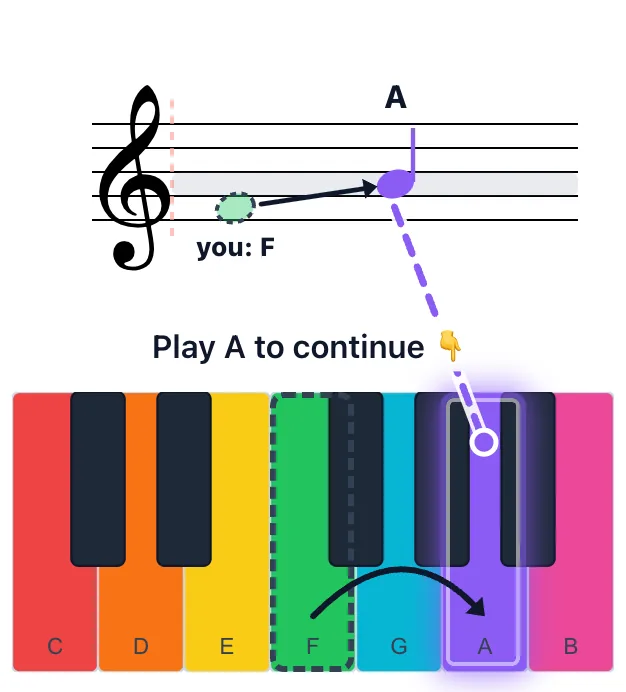
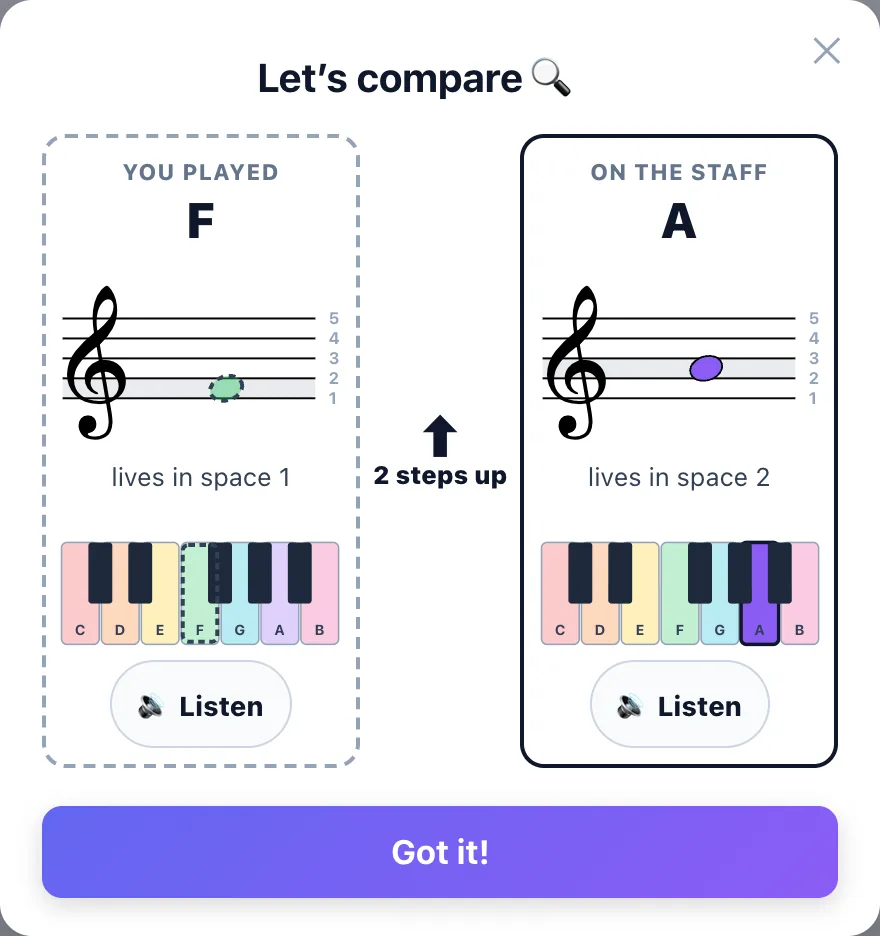
The missed note comes back shortly after, for a second chance — and at the end of the round the notes to practice are gathered together, each with its sound.
The line from the note to the key
A line connects the right note, on the staff, to its key — or to the button with its name. If the child waits, the game points to the key; if they still can't find it, it highlights the key and the staff together. There is always a way to reach the right note, and that confidence is what keeps the play — and the learning — going.
The training wheels come off
The colors and the line work like training wheels on a bicycle: the color fades on its own as the right answers add up, the line can be turned off once it is no longer needed, and the child moves on to reading real notation, in the same game adults use to build speed.
For parents and teachers
For parents and teachers: it runs right in the browser on a tablet, phone or computer, nothing to install. A few minutes a day is enough — it is reading practice disguised as a game, ideal as music-lesson homework.